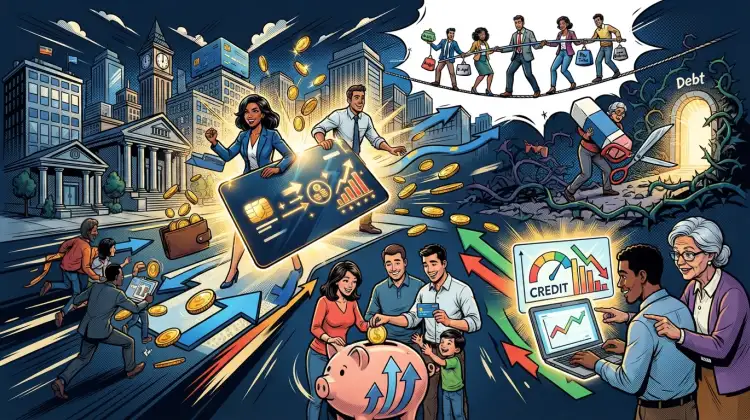
Credit cards are one of the most common financial tools in the United States, yet they are also one of the most misunderstood. Used carefully, a credit card can build your credit history, protect your purchases, and offer a convenient float between purchase and payment. Used carelessly, it can generate interest charges that compound quickly and damage the credit score you rely on for housing, insurance, and future borrowing. This guide explains the mechanics behind your card so you can make deliberate choices rather than reactive ones.
How a Credit Card Actually Works
A credit card is a revolving line of credit issued by a bank or credit union. When you make a purchase, the issuer pays the merchant and adds the amount to your balance. You then receive a monthly statement showing your balance, your minimum payment, and your payment due date. As long as you pay at least the minimum by the due date, the account stays in good standing, but any unpaid balance carries over and begins to accrue interest.
The credit limit is the maximum you can borrow at any time. Your available credit is the limit minus your current balance. Spending close to your limit signals risk to lenders and can hurt your credit score, even if you pay on time. A widely cited guideline is to keep your balance below 30% of your limit, and below 10% is better for your score.
The Grace Period, APR, and What Interest Really Costs
Most cards offer a grace period, typically at least 21 days between the statement closing date and the payment due date. If you pay your statement balance in full within that window, you owe no interest on new purchases. Once you carry a balance, the grace period on new purchases usually disappears until you pay in full again.
Interest is expressed as an annual percentage rate (APR), but it is charged daily on your average balance. A card with a 24% APR charges roughly 0.066% per day. On a $3,000 balance, that is about $2 per day, or roughly $60 per month, in interest alone. The minimum payment is often set at 1% to 3% of the balance, which means paying only the minimum can stretch repayment over years and cost far more than the original purchase.
Also watch for:
- Variable APRs that rise or fall with the prime rate.
- Penalty APRs, which can exceed 29% after a missed payment.
- Cash advance APRs, which are usually higher and start accruing immediately with no grace period.
- Balance transfer fees, typically 3% to 5% of the amount moved.
How Credit Cards Affect Your Credit Score
Payment history and credit utilization are the two most heavily weighted factors in FICO and VantageScore models. Payment history accounts for about 35% of a FICO score, and amounts owed account for about 30%. That means two habits matter more than almost anything else: paying every bill on time and keeping balances low relative to your limits.
Other factors include the length of your credit history, the mix of credit types, and new inquiries from applications. Opening several cards in a short period can lower your score temporarily. Closing an old card can also hurt, because it reduces your total available credit and therefore raises your utilization ratio. In most cases, keeping a long-held card open, even with a small recurring charge, supports your score.
Choosing the Right Card for Your Habits
Cards are not one-size-fits-all. Match the card to how you actually spend and repay.
- If you carry a balance: prioritize the lowest ongoing APR over rewards. A 0% introductory APR on purchases or balance transfers can help, but plan for the rate that follows.
- If you pay in full each month: rewards cards make sense. Cash-back cards are simple; travel cards can be valuable if you use the points. Compare annual fees against realistic earnings.
- If you are building or rebuilding credit: consider a secured card, which requires a refundable deposit that becomes your credit limit.
- If you want simplicity: a flat-rate cash-back card with no annual fee avoids category tracking.
Read the Schumer Box, the standardized disclosure that lists rates, fees, and terms. It is the fastest way to compare offers honestly.
Practical Habits That Keep Cards Working for You
Set up automatic payments for at least the minimum, then pay the full statement balance manually. Review statements for unauthorized charges and dispute them promptly under the Fair Credit Billing Act. Keep a small number of active cards rather than many dormant ones. Track your utilization monthly, and if it creeps above 30%, pay down the balance before the statement closes. Finally, avoid cash advances and treat rewards as a bonus, never a reason to spend.
What to Remember
Credit cards are a tool, not free money. The grace period is your friend only if you pay in full. Interest compounds daily, and minimum payments are designed to be slow. Your payment history and utilization drive your score, so on-time payments and low balances do most of the work. Choose a card that fits your repayment behavior, read the Schumer Box, and review your statement every month. Handled this way, a credit card becomes a reliable way to build credit and add convenience without adding debt.