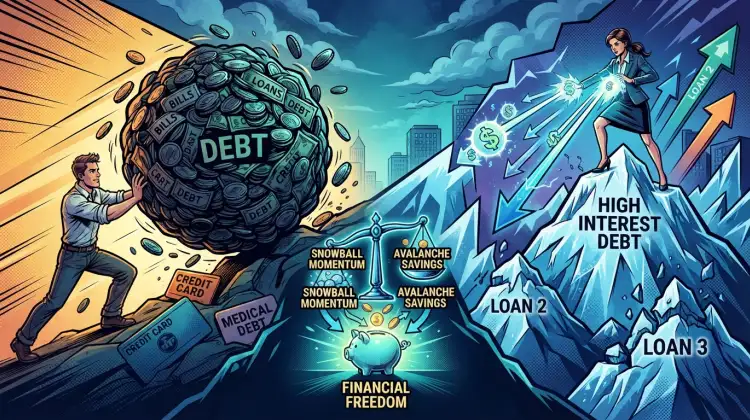
If you're juggling multiple balances, the order in which you pay them off matters more than most people realize. The two most widely discussed strategies are the debt snowball and the debt avalanche. Both require you to make minimum payments on every account and direct any extra money toward one target debt at a time. The difference is which debt you target first — and that choice affects both your total interest cost and your odds of sticking with the plan.
Here's how each method works, where the math and the psychology diverge, and how to pick the one that fits your situation.
How the Debt Snowball Works
With the snowball method, you list your debts from smallest balance to largest, regardless of interest rate. You pay the minimum on everything, then throw every available extra dollar at the smallest balance. When that account is paid off, you roll its payment into the next-smallest balance, and so on. Your monthly outlay stays constant while the number of accounts shrinks.
Example: suppose you owe $400 on a store card at 26% APR, $1,800 on a credit card at 22% APR, and $9,000 on a personal loan at 11% APR. The snowball targets the $400 store card first — even though it isn't your most expensive debt — because eliminating it quickly frees up cash flow and gives you a visible win.
How the Debt Avalanche Works
The avalanche method orders debts by interest rate, highest first. You still pay minimums on everything, but the extra money goes to the highest-APR balance. Once it's gone, you move to the next-highest rate.
Using the same example, the avalanche attacks the 26% store card first, then the 22% credit card, then the 11% personal loan. Because high-interest balances are retired sooner, the avalanche typically costs less in total interest and can shave weeks or months off your payoff timeline compared with the snowball.
The Real Trade-Off: Math vs. Motivation
The avalanche almost always wins on pure arithmetic. The gap depends on how different your interest rates are and how large the balances are. When rates are similar — say, several credit cards clustered between 20% and 24% — the savings from choosing avalanche over snowball are often modest. When one account carries a much higher rate, the avalanche advantage grows.
The snowball's case is behavioral. Research on debt repayment has found that consumers are more likely to persist when they close accounts quickly, even if the accounts are small. A 2016 study published in the Journal of Consumer Research found that people who focused on paying off the smallest balances first were more likely to eliminate their debts entirely, and that closing an account provided a motivational boost that carried into the next one.
In practice, this means the "best" method is the one you'll actually finish. A slightly more expensive plan you complete beats an optimal plan you abandon in month four.
Side-by-Side Comparison
- Target order: Snowball goes smallest balance first; avalanche goes highest interest rate first.
- Total interest: Avalanche usually costs less; snowball usually costs more.
- Speed of first win: Snowball delivers a paid-off account sooner in most cases.
- Motivation: Snowball is generally easier to sustain for people who need momentum.
- Best fit: Avalanche suits disciplined, math-driven payers; snowball suits those who've struggled to stay motivated.
How to Choose — and How to Execute Either One
Start by listing every debt: creditor, balance, APR, and minimum payment. Then ask yourself honestly whether you need quick psychological wins or whether you're motivated by minimizing cost. If you've tried and quit before, lean snowball. If you're comfortable delaying gratification, lean avalanche.
Whichever you choose, take these steps:
- Make minimums non-negotiable. Late payments damage your credit scores and trigger penalty APRs, which can erase any savings from your chosen method.
- Automate payments. Set up autopay for at least the minimum on every account to avoid missed due dates.
- Find extra money. The method only works if there's a surplus above minimums. Redirect bonuses, tax refunds, or trimmed expenses toward the target debt.
- Protect your credit along the way. Keep older accounts open, avoid new applications while paying down balances, and check your credit reports for errors at AnnualCreditReport.com.
- Consider consolidation carefully. A balance transfer card with a 0% introductory APR or a debt consolidation loan can lower your rate, but only if you won't run up the old balances again. Compare the transfer fee (often 3%–5%) against the interest you'd save.
One practical hybrid: use the snowball for momentum but prioritize any account with an APR above roughly 25%, since interest at that level compounds against you quickly. This captures most of the avalanche's savings while preserving the snowball's early wins.
What to Remember
The debt snowball and debt avalanche share the same engine — minimums on everything, extra money on one target — and differ only in ordering. The avalanche minimizes interest; the snowball maximizes momentum. For most people with several credit card balances, the dollar difference is smaller than the behavioral difference, so choose based on what keeps you paying. Automate minimums, apply every windfall to the target, and avoid new debt while you work the plan. If you want a structured starting point, the Consumer Financial Protection Bureau offers free debt and credit counseling resources that can help you build a payoff plan tailored to your accounts.