Compound interest is often called the eighth wonder of the world, but the concept is simpler than the saying suggests: you earn interest not only on your original deposit but also on the interest that deposit has already earned. The result is exponential growth that starts slowly and accelerates over time. The clearest way to understand it is to run the numbers. Below are concrete compound interest examples using realistic US savings and investing scenarios, along with the formula and the lessons each example teaches.
The Compound Interest Formula in Plain English
For a lump sum with no additional contributions, the future value is calculated as A = P(1 + r/n)^(nt), where P is your starting principal, r is the annual interest rate expressed as a decimal, n is the number of compounding periods per year, and t is the number of years. When interest compounds annually, n equals 1 and the formula simplifies to A = P(1 + r)^t.
For accounts where you add money regularly, the future value of an annuity formula applies instead, but the underlying idea is the same: every dollar you contribute starts earning its own compounding stream, and earlier dollars have more time to multiply. Most US savings accounts, certificates of deposit (CDs), and money market accounts compound daily or monthly, while stock market returns are typically modeled as annual compounding for simplicity.
Example 1: $10,000 in a High-Yield Savings Account
Suppose you deposit $10,000 in a high-yield savings account paying 4.00% annual percentage yield (APY), compounded monthly, and leave it untouched. Using A = 10,000(1 + 0.04/12)^(12 × 10):
- After 10 years: about $14,898 — you earned roughly $4,898 in interest.
- After 20 years: about $22,196 — total interest of roughly $12,196.
- After 30 years: about $33,067 — total interest of roughly $23,067.
Notice that the second decade produced more interest than the first, and the third produced more than the second. That acceleration is the signature of compounding. Keep in mind that savings rates fluctuate; the Federal Reserve's policy rate moves APYs up and down, so a 4% rate is a snapshot, not a guarantee.
Example 2: $500 a Month Invested in a Broad Index Fund
Now consider a more realistic wealth-building path: contributing $500 per month to a low-cost S&P 500 index fund inside a 401(k) or IRA. Historically, the S&P 500 has returned roughly 10% annually before inflation over long periods, though returns vary widely year to year and past performance does not guarantee future results. Assuming a 7% average annual return (a common planning figure that accounts for inflation and fees), the future value of those contributions is:
- After 10 years: about $86,600 on $60,000 contributed.
- After 20 years: about $260,500 on $120,000 contributed.
- After 30 years: about $610,000 on $180,000 contributed.
The gap between what you put in and what you end up with widens dramatically over time. In the 30-year case, more than $400,000 of the balance comes from compound growth rather than your own deposits.
Example 3: The Cost of Waiting Five Years
Time is the most powerful variable in the compounding equation, which is why delaying contributions is expensive. Compare two savers who both invest $400 per month at a 7% average annual return:
- Saver A starts at age 25 and stops at 65 (40 years): roughly $1,048,000.
- Saver B starts at age 30 and stops at 65 (35 years): roughly $710,000.
Saver B contributes $24,000 less but ends up with about $338,000 less. The missing five years of compounding cost far more than the skipped contributions. This is why financial planners consistently emphasize starting early, even with small amounts.
Example 4: Compounding Frequency and the Rule of 72
How often interest compounds matters, but less than most people expect. $10,000 at 5% for 20 years grows to about $26,533 with annual compounding, $27,126 with monthly compounding, and $27,181 with daily compounding. The difference between annual and daily compounding is only about 2.4% of the final balance — meaningful, but far less important than the rate and the time horizon.
A quick shortcut for estimating doubling time is the Rule of 72: divide 72 by your annual rate of return. At 6%, money doubles in about 12 years; at 8%, about 9 years; at 3%, about 24 years. It is a useful sanity check when comparing savings accounts, CDs, and investment projections.
Example 5: Compounding Against You — Debt and Inflation
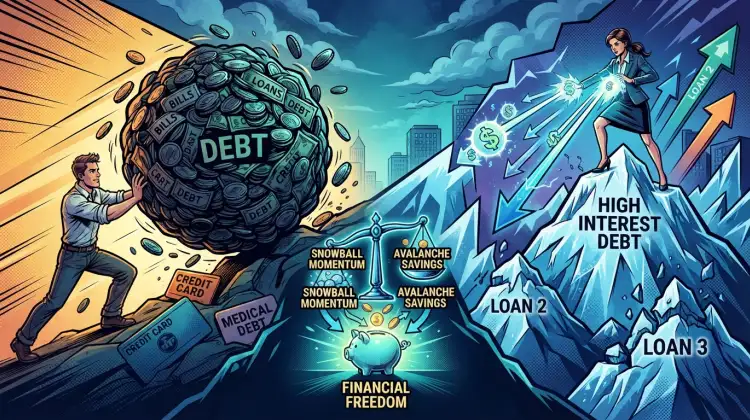
Compounding is not always your friend. A $5,000 credit card balance at a 22% annual percentage rate (APR), with no new charges and minimum payments, can take years to repay and cost thousands in interest. The same math that builds wealth in a retirement account builds balances owed on revolving debt. Inflation compounds too: at 3% annual inflation, $100,000 of purchasing power shrinks to about $74,400 in 10 years, which is why keeping long-term savings in cash alone carries risk.
How to Put These Examples to Work
Use these compound interest examples as a template for your own numbers. Start by identifying your time horizon, then estimate a realistic rate — APYs for savings accounts and CDs, long-run average returns for diversified stock funds. Run the calculation with a compound interest calculator or spreadsheet, and compare scenarios where you contribute more, start earlier, or choose a lower-cost fund. Small changes in rate and time produce large changes in outcome, so revisit the math annually as your income and account options change.
What to Remember
- Compounding means earning returns on your returns; growth accelerates over time.
- Time is the most influential variable — starting five years earlier can add hundreds of thousands of dollars.
- Compounding frequency matters, but rate and duration matter far more.
- The Rule of 72 gives a fast estimate of doubling time at any given rate.
- The same math works against you on high-interest debt and inflation, so pay down expensive debt and invest for long horizons.