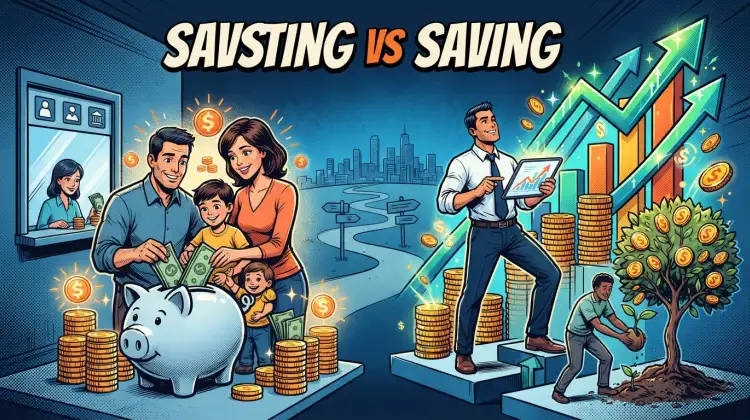
Saving and investing are both essential to a healthy financial life, but they do different jobs. Saving keeps your money safe and accessible for near-term needs, while investing puts your money to work in assets that can grow over time. The right balance depends on your goals, your time horizon, and your tolerance for risk. This guide explains how each works, where each belongs, and how to combine them into a plan that supports both security and long-term wealth.
What Is Saving?
Saving means setting aside money in low-risk, highly liquid accounts so it is available when you need it. Common vehicles include savings accounts, high-yield savings accounts, money market accounts, and certificates of deposit (CDs). These accounts are typically insured by the Federal Deposit Insurance Corporation (FDIC) up to $250,000 per depositor, per bank, per ownership category, which makes them among the safest places to keep cash.
The trade-off is modest growth. As of recent years, high-yield savings accounts have paid annual percentage yields (APYs) in the range of roughly 4% to 5%, though rates move with the Federal Reserve's policy decisions. Historically, savings rates have often lagged inflation, meaning the purchasing power of cash can erode over long periods. That is why savings is best suited to money you will need soon or cannot afford to lose.
Where saving fits best
- Emergency fund: Three to six months of essential expenses, kept liquid and untouched.
- Short-term goals: A home down payment within two to three years, a car purchase, or a wedding.
- Upcoming bills and sinking funds: Property taxes, insurance premiums, or holiday spending.
- Cash you cannot risk: Money earmarked for near-term obligations should not be exposed to market volatility.
What Is Investing?
Investing means putting money into assets such as stocks, bonds, mutual funds, exchange-traded funds (ETFs), or real estate with the expectation of earning a return over time. Investments are not FDIC-insured, and their value can fall as well as rise. In exchange for that risk, investors have historically earned higher average returns than cash over long periods.
According to historical data compiled by sources such as Vanguard and Morningstar, broad U.S. stock market indexes have returned roughly 9% to 10% annually on average over the long run before inflation, though returns vary widely year to year and past performance does not guarantee future results. Bonds have generally returned less, with lower volatility. The key driver of investment outcomes is time: the longer your horizon, the more opportunity you have to ride out downturns and benefit from compounding.
Where investing fits best
- Retirement: Accounts like a 401(k), traditional IRA, or Roth IRA are built for decades-long growth.
- Long-term goals: Education funding in a 529 plan, or wealth building beyond a 10-year horizon.
- Beating inflation: Growth assets aim to outpace rising prices over time.
- Compounding: Reinvested dividends and interest can snowball when left alone for years.
Key Differences Between Investing and Saving
Understanding the contrasts helps you assign the right dollars to the right place.
- Risk: Savings accounts are insured and stable; investments fluctuate and can lose value.
- Liquidity: Savings is accessible immediately; some investments take days to sell and settle, and retirement accounts may carry penalties for early withdrawal.
- Return potential: Savings offers modest, predictable interest; investing offers higher potential returns with uncertainty.
- Time horizon: Savings suits money needed within a few years; investing suits money you will not touch for five to ten years or more.
- Tax treatment: Interest on savings is generally taxed as ordinary income; investments may qualify for lower long-term capital gains rates and tax-advantaged accounts.
How to Balance Saving and Investing
Most people should do both, in a deliberate order. A practical framework looks like this:
- Build a starter emergency fund. Aim for at least one month of expenses in a high-yield savings account.
- Capture employer matches. Contribute enough to your 401(k) to earn any employer match, which is effectively free money.
- Pay down high-interest debt. Credit card balances often carry rates above 20%, which no investment reliably beats.
- Fully fund your emergency reserve. Grow it to three to six months of expenses.
- Invest for the long term. Increase retirement contributions and consider a diversified portfolio of low-cost index funds.
- Save for near-term goals separately. Keep short-term money out of the market so a downturn does not derail your plans.
Your asset allocation should reflect your timeline. Money needed in the next two to three years generally belongs in cash or short-term CDs. Money for goals a decade away can reasonably include a mix of stocks and bonds. As you approach a goal, shift toward safer holdings to protect what you have accumulated.
Common Mistakes to Avoid
- Investing your emergency fund. A market drop could force you to sell at a loss when you need cash most.
- Leaving long-term money in cash. Over decades, inflation can quietly erode purchasing power.
- Chasing high yields without understanding risk. Unusually high advertised returns often signal higher risk or fraud.
- Ignoring fees. A 1% annual fee can meaningfully reduce returns over 30 years; low-cost index funds typically charge well under 0.20%.
- Panic selling. Selling during downturns locks in losses and often means missing the recovery.
The Short Version
Saving and investing are complementary, not competing. Saving provides stability, liquidity, and peace of mind for short-term needs and emergencies. Investing provides the growth potential needed to build wealth and outpace inflation over long horizons. Start with a fully funded emergency savings account, take advantage of tax-advantaged retirement accounts and any employer match, then invest consistently in a diversified, low-cost portfolio for goals that are years away. Review your plan annually and adjust as your goals and timeline change.